
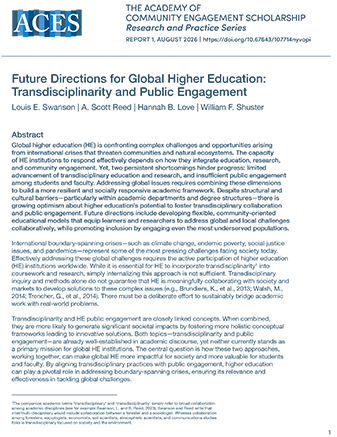
Future Directions for Global Higher Education: Transdisciplinarity and Public Engagement
Author(s)
Louis E. Swanson
A. Scott Reed
Hannah B. Love
William F. Shuster
Abstract
Global higher education (HE) is confronting complex challenges and opportunities arising from international crises that threaten communities and natural ecosystems. The capacity of HE institutions to respond effectively depends on how they integrate education, research, and community engagement. Yet, two persistent shortcomings hinder progress: limited advancement of transdisciplinary education and research, and insufficient public engagement among students and faculty. Addressing global issues requires combining these dimensions to build a more resilient and socially responsive academic framework. Despite structural and cultural barriers—particularly within academic departments and degree structures—there is growing optimism about higher education’s potential to foster transdisciplinary collaboration and public engagement. Future directions include developing flexible, community-oriented educational models that equip learners and researchers to address global and local challenges collaboratively, while promoting inclusion by engaging even the most underserved populations.
Date of publication
August 2026
DOI
https://doi.org/10.67643/107714nyvopi
Resource type
Report
Series
Research and Practice
Language
English
Citation (APA)
Swanson, L. E., Reed, A. S., Love, H. B., & Shuster, W. F. (2026). Future Directions for Global Higher Education: Transdisciplinarity and Public Engagement. The Academy of Community Engagement Scholarship. https://doi.org/10.67643/107714nyvopi
Download PDF
File size: 528 KB